I have a Dreame Z10 Pro robot vacuum cleaner. This RoboVacuum has a water tank attachment that is supposed to keep the mop wet. Because the water where I live has quite high hardness, the tiny tubes and nozzles clog quickly, causing the mop to run dry.
Luckily, this is rather easy to fix. Let me show you how:
The Mop Attachment
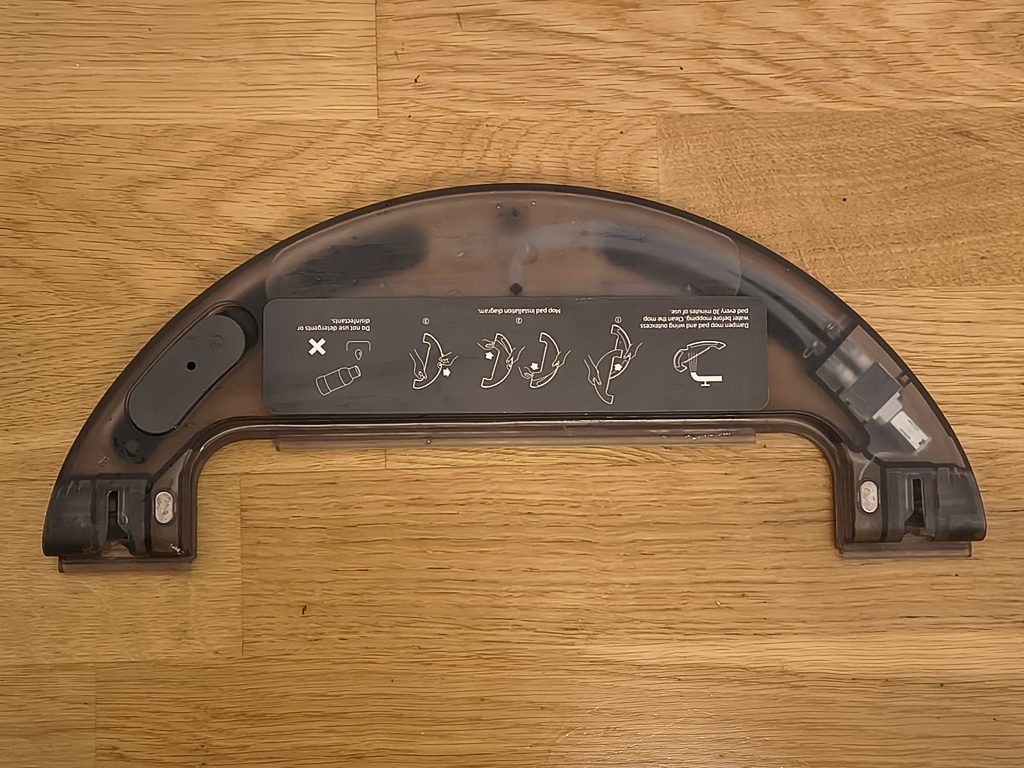
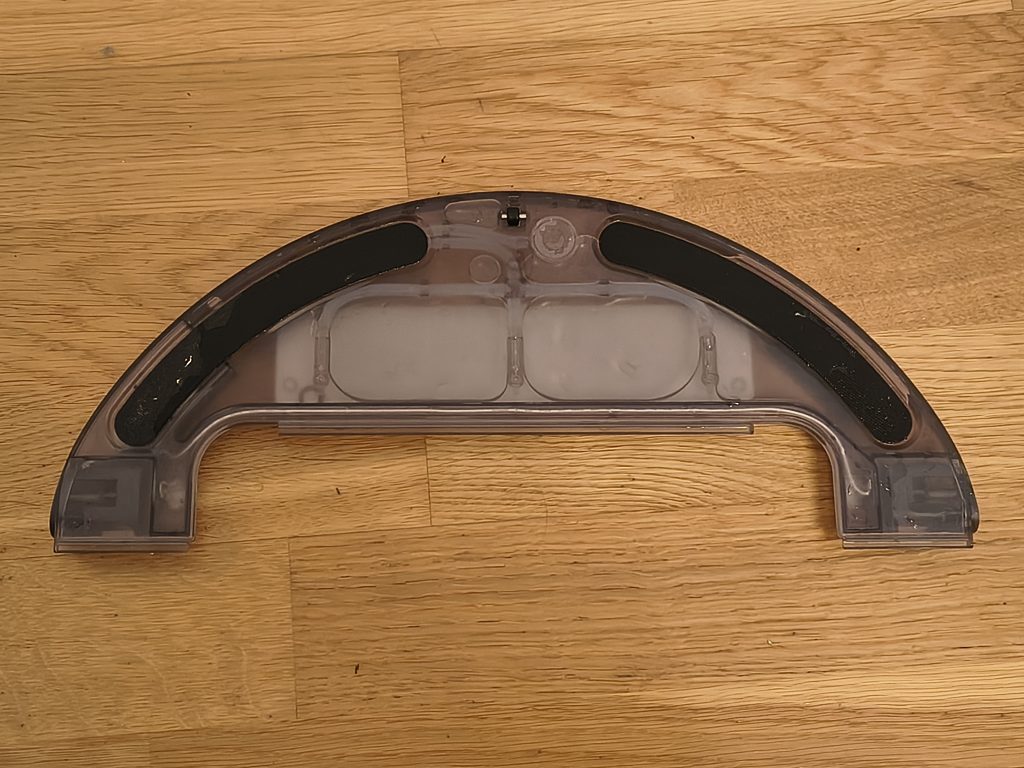
This is what the mop attachment looks like. It’s construction is rather simple: There is a water tank that can be filled through the fill port under a rubber seal on the top. Inside, you can see a small motor. It drives a tiny pump, that draws in water from a sump and pumps it out of three tiny nozzles at the leading edge of the mop attachment (lower edge in the pictures). Voltage is supplied through the two metal contacts visible on the top side.
Voltage and Current
There is no marking of polarity or voltage. Luckily, it is quite easy to figure out:
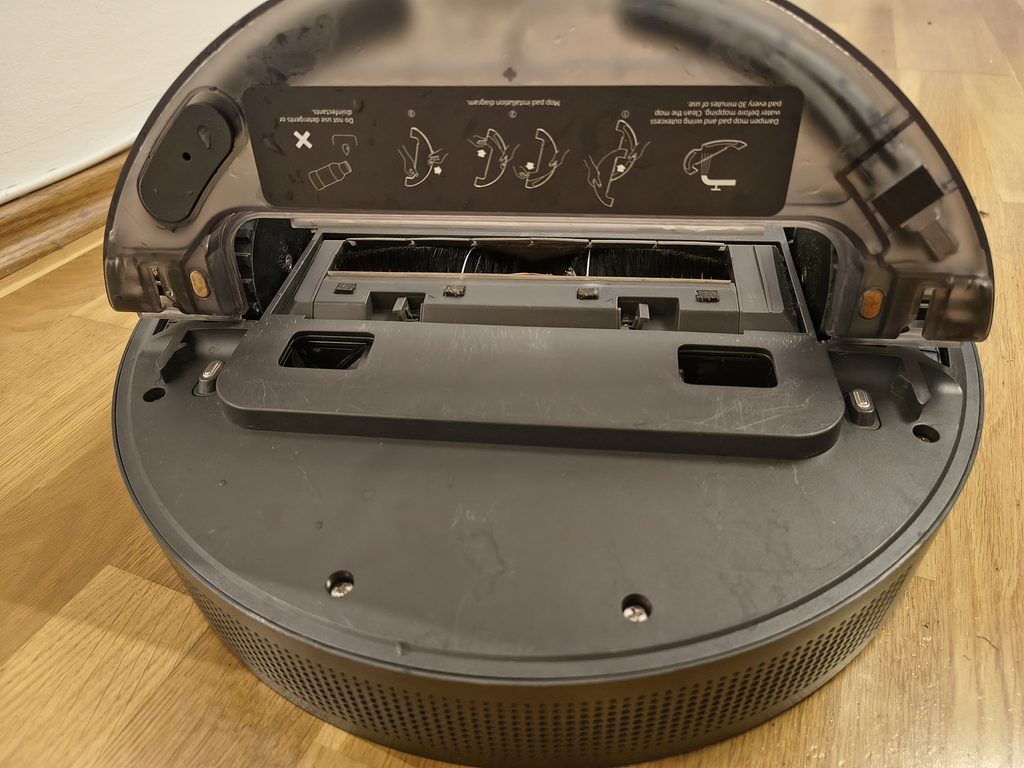
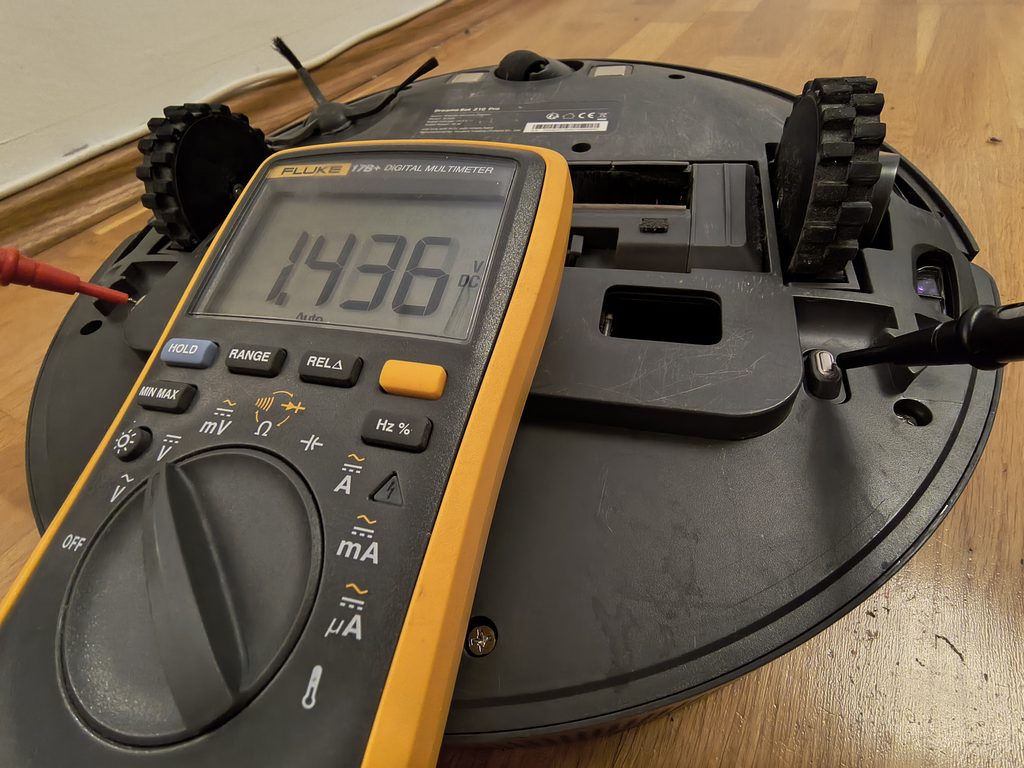
The robot supplies a permanent voltage to the two pins on its underside. I assume this is how it can detect if the tank is present or not – by testing for continuity between these two pins. I also assume that it monitors the current, and once the tank has been detected, it will only send power to the motor once it is driving. The amount of water dispensed is also configurable, so this has to be controllable.
Conveniently, this also allows us to figure out the polarity: There are approximately 1.5 V present on the two contacts, with + (red) on the robot’s right and – (black) on the robots left when viewing the upright robot from the top.
Running the Pump
Obviously, it’s “on your own risk” territory from here on
With this information, we can run the pump when removed from the robot, by supplying voltage through a bench power supply. Just supply 1.5 V to the contacts on the mop attachment directly. It consumes very little power; when the pump is working, I saw 50 mA at 1.5 V.
I usually find that when the nozzles are clogged, the pump does not manage to squirt out any water from the nozzles. In that case, we can try to run the pump with a bit more power (2.2 V was still fine in my testing, but take care not to burn out the motor by running it too long). Reversing polarity also does not seem to kill it, and maybe even helps work loose the obstructions in the tubes.
Descaling
If running or even overvolting the pump does not help to unclog the nozzles, I had some luck by filling the tank with a bit of descaling fluid. Shaking the tank and running the pump back and forth usually manages to get it working again. You know you are good when water dribbles/sprays out of all three nozzles on the underside.
Afterwards, just flush it out again with water. The descaling agent may be quite harsh on the seals, but I’m sure its fine for a short amount of time.
Happy Mopping!
For me, that was all that’s needed to get the mop attachment working again. Reattach the mopping pad and look at it go!